Cold Plunge After Your Workout: The Complete Post-Exercise Recovery Guide
Why Post-Workout Is the Best Time to Cold Plunge
You just crushed a workout. Your muscles are inflamed, your heart rate is elevated, and metabolic waste products like lactic acid are flooding your tissues. This is the exact moment when cold water immersion delivers its most powerful benefits.
A 2023 meta-analysis published in Frontiers in Physiology — analyzing 20 randomized controlled trials spanning two decades — found that cold water immersion immediately after exercise significantly reduces delayed-onset muscle soreness (DOMS) and lowers creatine kinase levels (a key marker of muscle damage) within 24 hours. The researchers concluded that immersing in cold water right after training is the single most effective timing for recovery.
For athletes and fitness enthusiasts across Orange County, this means one thing: if you are not cold plunging after your workouts, you are leaving recovery on the table.
What Happens to Your Body During a Post-Workout Cold Plunge
When you step into water between 38-50°F after exercise, your body initiates a cascade of recovery-accelerating responses:
Rapid Vasoconstriction
Cold water causes your blood vessels to constrict immediately. This reduces blood flow to inflamed muscle tissue, limiting the extent of exercise-induced swelling. According to the Mayo Clinic, this rapid constriction is the primary mechanism behind cold water immersion's ability to reduce muscle damage and soreness.
Once you exit the cold water, your vessels dilate again — creating a powerful "pump" effect that flushes metabolic waste products out of your muscles and delivers fresh, oxygen-rich blood to damaged tissue.
Reduced Creatine Kinase and Lactate
Creatine kinase (CK) is released into your bloodstream when muscle fibers are damaged during exercise. Elevated CK levels correlate directly with muscle soreness and impaired performance. The Frontiers in Physiology meta-analysis found that post-exercise cold water immersion significantly reduced CK levels at 24 hours and lowered blood lactate at both 24 and 48 hours after training.
In practical terms: less CK means less damage, less soreness, and faster return to peak performance.
Norepinephrine Surge
Cold exposure triggers a massive release of norepinephrine — a neurotransmitter that sharpens focus, elevates mood, and reduces perceived pain. Research from the European Journal of Applied Physiology shows that cold water immersion can increase norepinephrine levels by 200-300%. This is why many athletes describe feeling energized and mentally clear after a post-workout cold plunge, rather than the typical post-training fatigue.
Stress Reduction
A 2025 study published in PLoS ONE — analyzing 11 studies with over 3,100 participants — found that cold water immersion significantly reduced stress markers 12 hours after the session. For athletes juggling training with work and life in Newport Beach or Irvine, this dual benefit of physical recovery and mental stress relief makes post-workout cold plunging especially valuable.
The Optimal Post-Workout Cold Plunge Protocol
Not all cold plunges are created equal. Based on the latest research, here is the evidence-based protocol for maximizing post-workout recovery:
Temperature
The most effective temperature range is 38-50°F (3-10°C). A comprehensive review by Machado et al. found that water temperatures between 50-59°F (11-15°C) for 11-15 minutes produced the most consistent recovery benefits. However, colder temperatures (38-45°F) allow for shorter, equally effective sessions.
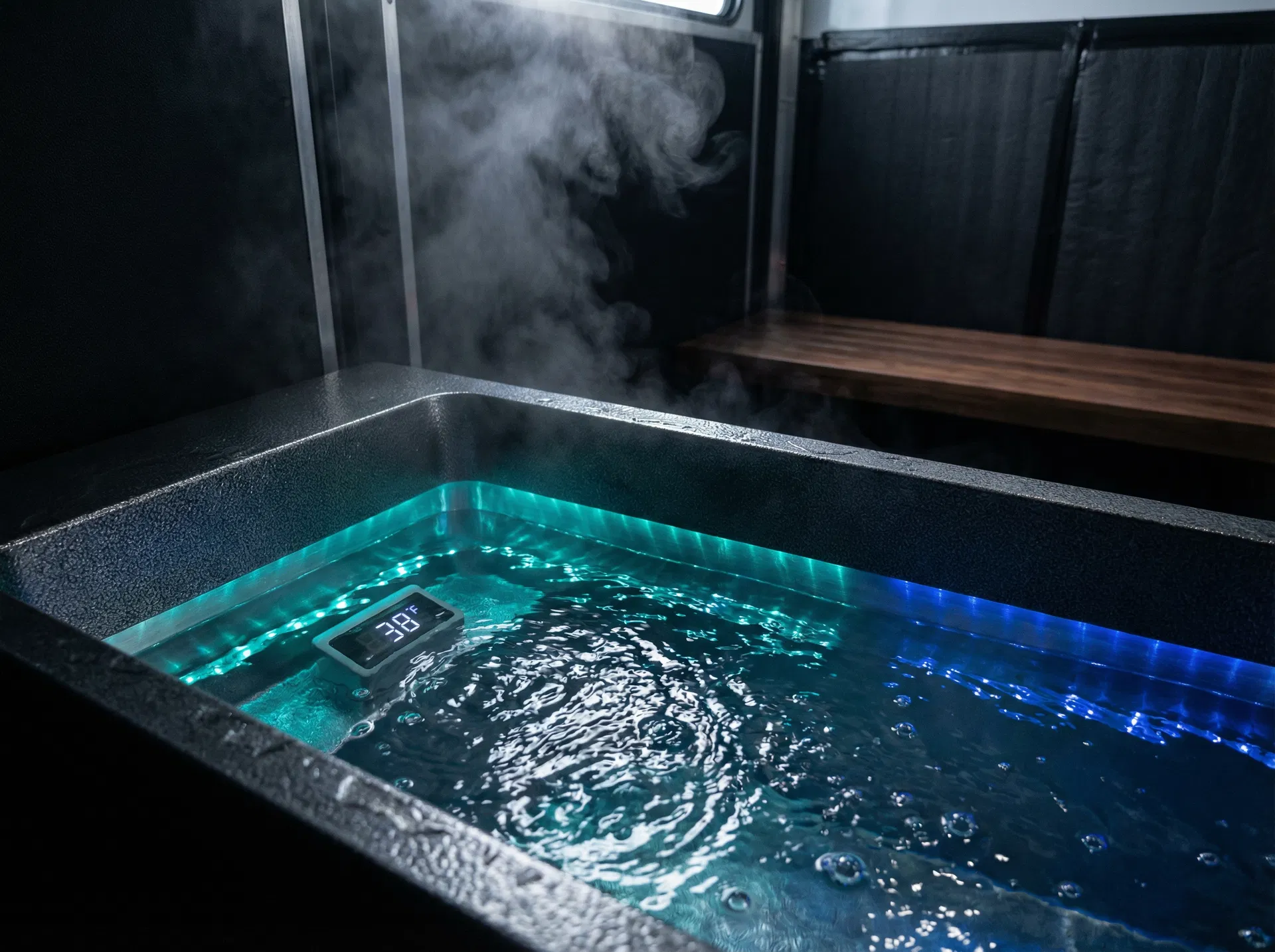
At The Recovery Machine, our mobile cold plunge maintains precise temperatures between 38-45°F — the range used by professional sports teams and elite recovery facilities.
Duration
The research supports a clear dose-response relationship:
- •Beginners: 1-3 minutes at 45-50°F
- •Intermediate: 3-5 minutes at 40-45°F
- •Advanced: 5-10 minutes at 38-42°F
A 2025 study in Frontiers in Physiology confirmed that even short-duration immersions under 10 minutes provide immediate recovery benefits, particularly for reducing muscle soreness.
Timing After Exercise
The meta-analysis data is clear: immediately after exercise is optimal. The sooner you immerse after training, the more effectively you limit the inflammatory cascade and muscle damage. Waiting more than 2 hours significantly reduces the recovery benefits.
This is exactly why mobile recovery changes the game. Instead of driving 30 minutes to a recovery studio after an exhausting workout, The Recovery Machine meets you at your home, gym, or training facility — so you can plunge within minutes of finishing your session.
The Strength Training Caveat: When NOT to Cold Plunge
Here is the nuance that most cold plunge articles miss — and it is critical for anyone doing resistance training.
A landmark 2015 study published in The Journal of Physiology by Roberts et al. (cited over 400 times) found that cold water immersion immediately after strength training can attenuate the anabolic signaling pathways responsible for muscle growth. In other words, if your primary goal is building muscle (hypertrophy), plunging right after lifting may blunt your gains.
The mechanism: cold water suppresses the inflammatory response that is actually necessary for muscle adaptation after resistance training. Your body needs some inflammation to trigger the repair-and-rebuild process that makes muscles stronger.
The Smart Approach for Strength Athletes
- •After endurance training (running, cycling, swimming, surfing): Cold plunge immediately. Research shows no negative effect on endurance adaptations.
- •After strength training (lifting, CrossFit, resistance work): Wait at least 4 hours before cold plunging, or save it for a separate recovery day.
- •After competition or game day: Cold plunge immediately. When performance tomorrow matters more than long-term adaptation, prioritize recovery.
- •After mixed training: Use your judgment based on your primary goal for that session.
This is why many of our clients in Huntington Beach and Costa Mesa schedule their Recovery Machine sessions on dedicated recovery days — getting the full benefit of contrast therapy (cold plunge + sauna) without interfering with their strength training adaptations.
Post-Workout Cold Plunge vs. Other Recovery Methods
How does cold water immersion stack up against other popular recovery strategies?
Cold Plunge vs. Passive Rest: A Cochrane review of 17 trials (366 participants) found that cold water immersion significantly reduced muscle soreness compared to passive recovery (doing nothing). There is no contest — active cold recovery beats sitting on the couch.
Cold Plunge vs. Stretching: While stretching improves flexibility, it has minimal impact on reducing DOMS or accelerating tissue repair. Cold plunge addresses the root cause — inflammation and metabolic waste — rather than just the symptoms.
Cold Plunge vs. Compression: Compression garments provide modest benefits for recovery, but the effect size is smaller than cold water immersion across most studies.
Cold Plunge + Sauna (Contrast Therapy): This is the gold standard. Alternating between our 150°F Finnish sauna and 38°F cold plunge creates a vasodilation-vasoconstriction cycle that dramatically accelerates circulation, flushes waste products, and delivers nutrients to damaged tissue. Research shows contrast therapy can accelerate recovery by 40-60% compared to cold plunge alone.
Building Your Post-Workout Cold Plunge Routine
Here is a practical weekly framework based on the research:
For Endurance Athletes (surfers in Dana Point, runners in Laguna Beach, cyclists):
- •Cold plunge after every hard training session (3-4x per week)
- •3-5 minutes at 38-45°F
- •Combine with sauna on recovery days for contrast therapy
For Strength Athletes (CrossFit in Irvine, gym-goers in Anaheim):
- •Cold plunge on non-lifting days or 4+ hours after training
- •2-3 dedicated contrast therapy sessions per week
- •Focus on recovery days for maximum benefit without blunting adaptations
For Weekend Warriors (active professionals in Tustin, Mission Viejo):
- •Cold plunge after your hardest workout of the week
- •1-2 sessions per week for consistent recovery benefits
- •Combine with sauna for the ultimate weekend recovery ritual
Why Mobile Recovery Makes Post-Workout Cold Plunge Actually Work
The science is clear: timing matters. The sooner you cold plunge after exercise, the better the results. But here is the reality — most people do not have a cold plunge at home, and driving to a recovery studio after an exhausting workout is the last thing anyone wants to do.
That is exactly why The Recovery Machine exists. We deliver a professional-grade cold plunge (plus Finnish sauna and red light therapy) directly to your door anywhere in Orange County. You finish your workout, walk outside, and recover — no driving, no waiting, no membership.
Our mobile unit maintains precise temperatures between 38-45°F, and our team guides you through the optimal protocol based on your training and goals.
Ready to add post-workout cold plunge to your routine? Book your first session and experience why Orange County's most serious athletes recover with The Recovery Machine.
Ready to Try It?
Book a mobile recovery session delivered to your door in Orange County.
Book Your Session